Čo je

nov 6. 2026
KInIT at EMNLP 2026
EMNLP is one of those conferences where you quickly realise just how much is happening in natural language processing. There is always another presentation to attend, another poster to stop by or someone whose work makes you curious. This year’s conference in Budapest was a busy one for our team, with five papers on the programme and a lot of interesting research to discover.
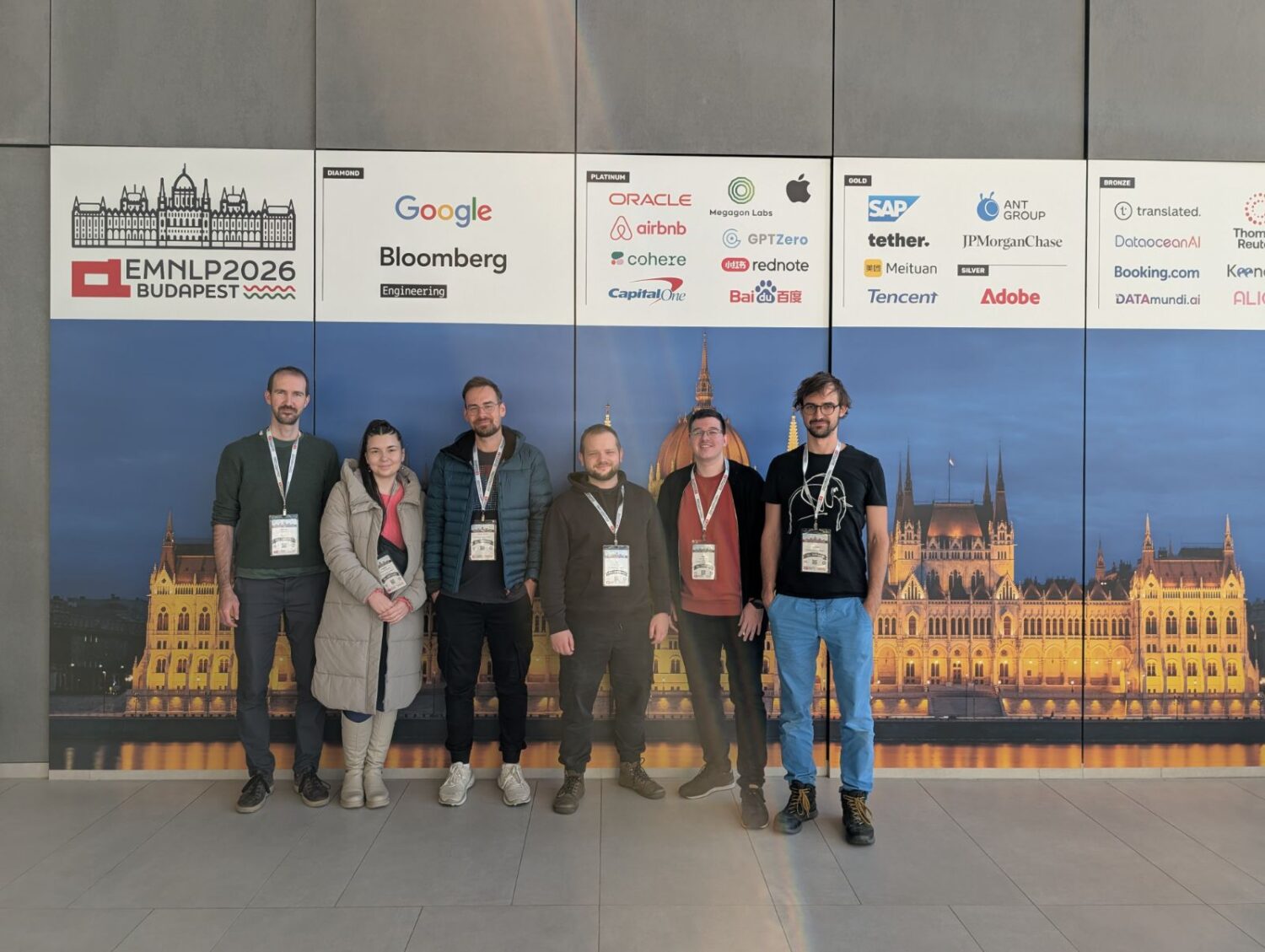
The conference took place from October 24th to 29th, and eight members of our team joined: Andrej Ridzik, Ivan Vykopal, Michal Gregor, Natália Kňažeková, Viktor Gregor, Jaroslav Kopčan, Ján Čegiň and Dominik Macko.
The research we brought to Budapest
This year’s contributions covered several areas of natural language processing, including Slovak language model evaluation, explainability, synthetic data generation and the detection of AI-generated text.
The conference through our researchers’ eyes
A conference is as much about the people you meet as the research you present. Researcher Ján Čegiň presented his work on using activation steering to generate synthetic data for low-resource languages during a poster session.
“It was especially rewarding to see so much interest in the work and to exchange ideas with people working on related problems,” he shared.
Dominik Macko, another of our researchers, had a slightly different experience. He presented his work at a smaller workshop after the main conference had ended, when many participants had already left. It was a quieter setting, with fewer visitors at his poster, but he still enjoyed the conversations with those who stopped by to hear about his research.


Reconnecting with the wider research community was particularly valuable to researcher Michal Gregor.
“EMNLP was a great opportunity to meet our colleagues, mainly those working across European universities and research institutes, and also get introduced to new people that we might collaborate with in the future,” he said.
He was also interested in the work on reasoning presented by researchers from China. However, language barriers sometimes made it difficult to have deeper conversations about the research.
Research engineers Andrej Ridzik and Viktor Gregor also had a lot to take in. Andrej described the experience as enjoyable but exhausting, with more interesting presentations and posters than he could fit into his schedule.
For Viktor, one notable trend was the growing focus on large audio-language models (LALMs) in the speech research presented at the conference. He sees this as an important direction for our team’s future work.
Beyond the research presentations, some conversations also touched on broader questions about the direction of NLP. Our research engineer Jaroslav Kopčan noticed that concerns about AI-generated papers and reviews came up several times. At the conference business meeting, he recalled someone calling for a code of conduct addressing low-quality AI-generated content in slides and keynotes. The suggestion was met with applause.

Jaroslav understands why people are concerned, but he does not think AI is the whole problem. Poor papers existed long before large language models. What has changed, though, is how easy and inexpensive they are to produce.
“It mostly amplifies what the system already rewards, and too often that’s the number of papers rather than the ideas in them. Maybe that’s what we should be rethinking.”
Still, Jaroslav does not see the situation as entirely negative. Faster experimentation can lead to interesting ideas, even if it also makes it harder to recognise which ones are worth pursuing.
“On the bright side, we can now iterate on ideas much faster than before, and some of that will lead somewhere really interesting.”
Until next time, EMNLP!
We had a really great time at EMNLP 2026, and it’s safe to say Budapest left us with a lot to remember. We’re happy to have been part of this year’s conference and, of course, already looking forward to the next one!