


Research Group

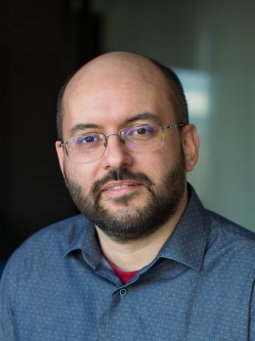
Michal Gregor
Research areas: large language models, reinforcement learning, reasoning, deep learning, multi-modal learning
Position: Researcher
Michal Gregor is a researcher at the Kempelen Institute of Intelligent Technologies, working in natural language processing and machine learning. His current research focuses on large language models (LLMs), low-resource and multilingual NLP, currently especially on efficient adaptation of large language models to low-resource settings such as skill-preserving adaptation of language models, reasoning-enabled learning, reinforcement learning for LLMs, etc.
Michal’s prior research background includes areas such as deep learning, reinforcement learning, incorporation of prior knowledge into machine learning, metaheuristic optimization, uncertain knowledge representation, probabilistic models, etc.
Michal has participated in national and international research projects as a researcher and has also led projects as the principal investigator / institutional coordinator. His international experience includes research visits and secondments at DFKI, University of Strathclyde, UC Berkeley, Tongji University, and University of Patras.
Selected activities
- Co-organization of NLP summer/winter schools at KInIT and, previously, the annual Machine Learning Summer School at the University of Žilina.
Professional service
- Program committee / reviewer roles: ACM Multimedia 2026 Program Committee member / reviewer; ECAI 2025 reviewer; SemEval 2026 and 2027 Task Selection Committee member / reviewer.
- Co-organizer and reviewer: SemEval 2025 Shared Task “Multilingual and Crosslingual Fact-Checked Claim Retrieval”; LowResNLP 2025 workshop at RANLP 2025.
- Editorial boards and earlier service: Applied Computer Science; Enterprise Management; program committee member for ICANN 2021, Cybernetics & Informatics 2018, EAN 2017, …
Selected Projects




Selected Publications
Investigating Language and Retrieval Bias in Multilingual Previously Fact-Checked Claim Detection
Vykopal, I., Karamolegkou, A.1, Kopcan, J., Peng, Q.1, Javurek, T., Gregor, M., Simko, M. 1 University of Copenhagen, Denmark, Copenhagen Multilingual Large Language Models (LLMs) offer powerful capabilities for cross-lingual…
Multimodal and Multilingual Fact-Checked Article Retrieval
Papadopoulos, S.1, Beňová, I., Kula, S., Gregor, M., Karantaidis, G.1, Javůrek, T., Šimko, M., Papadopoulos, S.1 1 Centre for Research and Technology, Hellas, Information Technologies Institute, Thessaloniki, Greece Fact-Check Retrieval…
Selected student supervising
PhD. Students
- Kristína Okasová (2025); KInIT and VUT Brno. Topic: Addressing the Limitations of Large Language Models.
Kristína’s research concerns areas such as limited reasoning and execution capabilities of large language models and addressing them through means such as architectural and methodological improvements.
Interns@KInIT
- Tomáš Majerčík (2025); Student of the Slovak Technical University in Bratislava, interning at KInIT; Topic: Adaptation of large language models to low-resource languages using insights from mechanistic interpretability.
- Pavol Kebis (2024); Graduate of the Comenius University in Bratislava and University of Oxford, interning at KInIT. Topic: Efficient adaptation of large language models to low-resource languages.
- Kristína Sásiková (2024); Student of the Commenius University in Bratislava participating in the DisAI Replication Challenge; Topic: Replicating paper Scaling Sentence Embeddings with Large Language Models.
- Michael Pavlík (2023); Intern from Tilburg University. Topics: unsupervised reasoning and self-correction in LLMs.
Interns@UNIZA
- Gaétan Becker (2022); Intern from Télécom SudParis. Topics: Deep learning architectures for predicting a quantity from other data during sensor outage.
- Sylvain Courty (2019); Intern from Université d’Angers. Topics: Probabilistic generation of synthetic data for visual object detection.
- Daniel Adamkovič (2017–2018); Intern from UNIZA. Topics: Machine learning, deep learning, reinforcement learning, …
Info about other graduate and undergraduate students supervised here.