



Research Group
Publication
Authors Gürtler, P., Yoldaş, T., Bellon, J., Kotková, A., McIntyre, A., Mesarčík, M., Šimko, J., Soľárová, S.& Dorsch, J.
Publish date July 2026
Download Download publication
Share publication Official LinkImproving Existing EU Policy To Preserve Cognitive Agency: Democracy in AI-Mediated Environments
Gürtler, P., Yoldaş, T., Bellon, J., Kotková, A., McIntyre, A., Mesarčík, M., Šimko, J., Soľárová, S.& Dorsch, J.
This is the first policy brief in a series on “Democracy in AI-Mediated Information Environments” and
focuses on improving existing legislative frameworks, namely the DSA, the AI Act, and the
Democracy Shield Initiative.
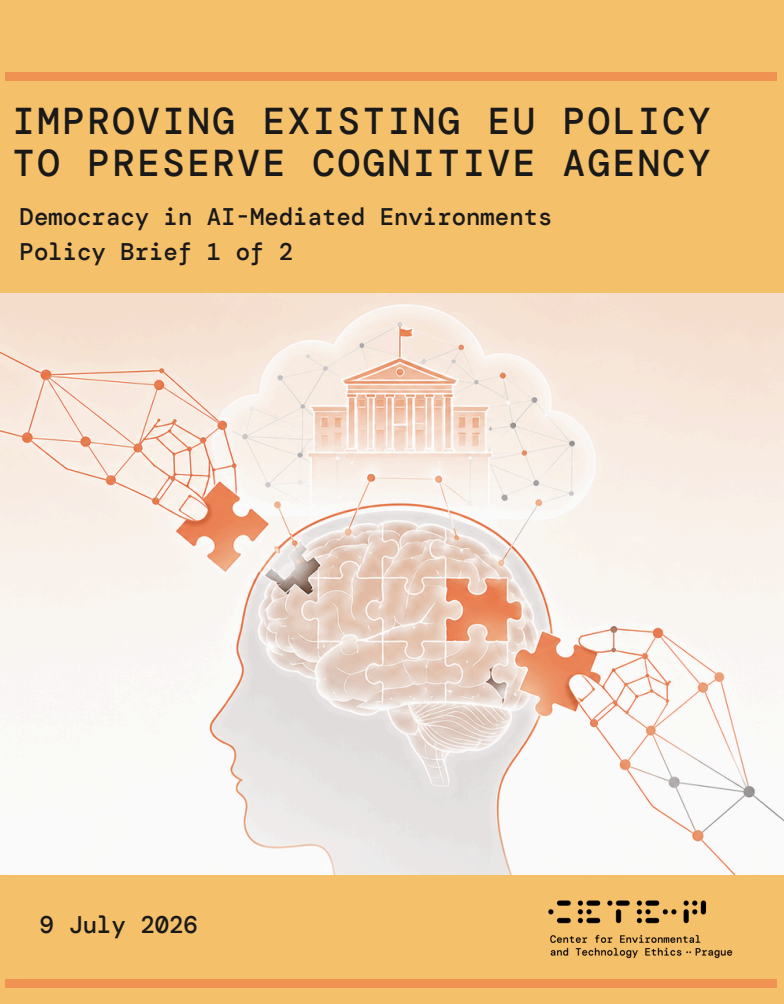
The problem that social media and generative artificial intelligence present for democracy is not limited to individual instances of mis/disinformation. They are driving a structural transformation of online information environments, making it increasingly difficult for citizens to determine which sources are credible, which claims are trustworthy, and whether content is human-generated or synthetic. This transformation is undermining cognitive agency, namely, citizens’ ability to assess and revise beliefs independently. Without it, democratic deliberation and self-determination falter. Existing EU regulation does not adequately address this structural transformation.
We recommend three policy interventions:
- Expand the definitions of systemic risk and manipulation in the AI Act and the DSA to capture harms from synthetic content to information environments.
- Strengthen cognitive agency by expanding digital literacy programs in the Democracy Shield Initiative.
- Improve DSA enforcement to protect information environments through better research access and resources.
Cite:
Gürtler, P., Yoldaş, T., Bellon, J., Kotková, A., McIntyre, A., Mesarčík, M., Šimko, J., Sol’árová, S.& Dorsch, J. (2026). Improving Existing EU Policy To Preserve Cognitive Agency: Democracy in AI-Mediated Environments. Zenodo. https://doi.org/10.5281/zenodo.21278799