What's
Jun 23. 2026
How Students Help (Us) Audit Social Media Recommendation Algorithms
Pytlík, M., Macák, E., Tvaroh, M.
During September 2025, students from the DELTA Secondary School of Informatics and Economics in Pardubice, Czech Republic, took part in an internship in KInIT, and specifically cooperated with the AI-Auditology team. With a great honor, the AI-Auditology team accepted an opportunity to follow up and also supervise their high school graduation thesis, which they recently successfully defended. In this blog, DELTA students summarize their experience on developing their own algorithmic audit under our supervision.
Our work focused on auditing Instagram’s “For You” feed recommendation algorithm directly on physical Android mobile devices. In this blog post, we take you behind the scenes of our journey, focusing on how we developed the auditing system, the technical hurdles we had to clear, our experimental results, and the feedback from our experience. The core principles of our work are built upon the research from the AI-Auditology project by KInIT, and checking out their initial study provides the perfect foundation for understanding the mechanics of what we built.
Our journey started during a September internship when we were selected as a specific group of students from the DELTA School to spend a month at the KInIT research institute in Bratislava. There, we got to know the team and their AI-Auditology project, and we were given a choice: build a web app to visualize audit results or create a “mobile agent” to mimic real human behavior on the TikTok platform using Android phones. We chose the second option and dove into researching the best technologies for the job. We designed a precise set of artificial interactions worrying about things like screen touch positions, finger trajectories, and human-like timing so that the platform wouldn’t detect our automated accounts. The fact that we didn’t get banned a single time proved that our approach worked. To link our mobile agent to KInIT’s existing predictive system, we needed unique video IDs, which we eventually obtained by rooting the phones and digging into their internal files. By the end of September, we agreed to continue working with KInIT to build a complete system for auditing Instagram Reels on Android smartphones.
To pull off this project, we split into a team of three and worked hard from October 2025 until the end of May 2026. We divided the work into three main parts: Martin Pytlík focused on building the mobile agent that controls the phones, Erik Macák worked on the predictive system that decides how a user would interact and Michal Tvaroh created the visualization tool to turn our data into easy-to-understand graphs. Before writing any code, we spent the month of October setting up our team workflow, analyzing how real people behave on social media, and figuring out our tech stack, which allowed us to start actual development in November.
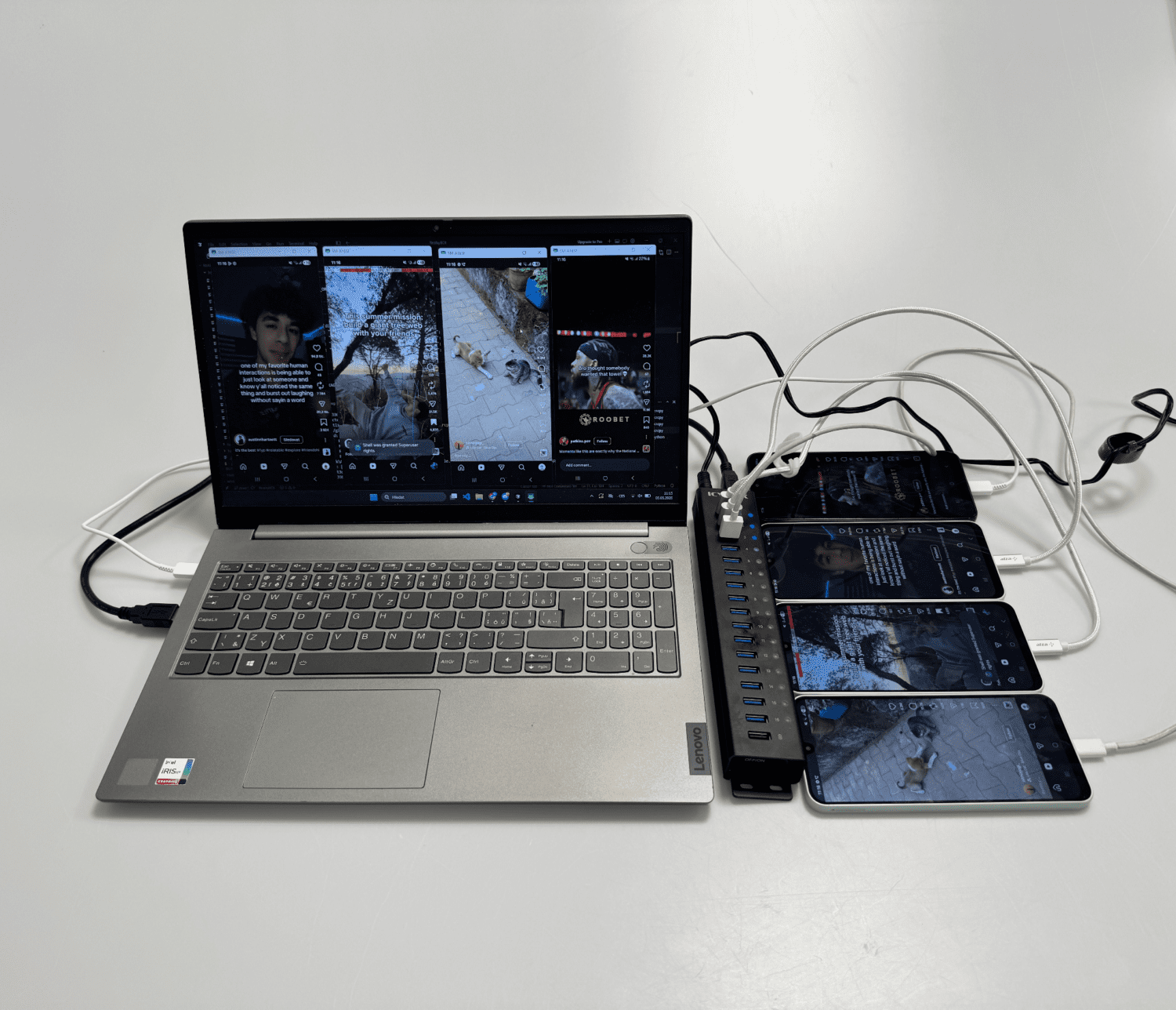
The mobile agent we built acts as the physical muscle of the project, controlling the smartphones connected to our computer. Once we turn the system on, it automatically wakes up the phones, opens Instagram, and navigates straight to the Reels tab. From there, it runs in a continuous four-step loop. First, it scrapes data from the screen like the creator’s username, the caption, views, and comments by grabbing the video ID from the phone’s internal database or memory. Second, it sends this data to our prediction system. Third, it receives instructions on what to do next. Finally, it performs the action like liking or skipping and swipes to the next video, starting the cycle all over again.
The predictive system serves as the actual brain of our project, figuring out exactly how a specific type of user would react to a video. We pre-load the system with different user profiles based on age, gender, interests, etc. When the mobile agent sends over a video’s details, the system validates them, figures out how popular the video is, and breaks it down into shorter segments. Analyzing a whole video takes too much computing power, so the system only downloads and analyzes small parts, just like a human making a quick split-second decision. It extracts key frames and listens to the background music, combining these elements with all the other available video metadata and the specific user representations. It then passes this complete package of information to a fast and precise AI model to evaluate the topic, language, evoked emotions, technical quality, and more. This output goes through a decision tree based on real social media trends, which calculates the final reaction, stores it, and tells the mobile agent what to do. The best part is that this system works across multiple platforms, supporting TikTok, Instagram, and YouTube regardless of whether the audit is conducted on a phone, computer, or elsewhere.
The data visualization tool is what helps us make sense of all this information, turning massive logs of raw data into clear charts that anyone can understand. The tool takes a big spreadsheet of every single interaction and organizes it into six different sections, showing everything from a general overview of the data to deep dives into filter bubbles and age comparisons. We picked specific chart styles for different questions so that everything looks consistent. One of our favorite features is a custom module that separates whether the feed is adapting to what you like or trying to push a certain attitude. Ultimately, it generates fourteen charts and a summary table that are perfect for both researchers and lawmakers.
Developing this entire setup wasn’t easy, and we hit quite a few technical brick walls along the way. For starters, rooting the phones to get to the hidden video IDs took a lot of troubleshooting. We also had to spend a lot of time fine-tuning the automated swipes and taps so they looked completely human and didn’t trigger any security flags. On top of that, making the AI backend fast enough to respond in seconds was crucial to keep the scrolling natural. But our biggest ongoing headache is that social media apps change their design and code constantly, meaning we always have to update our mobile agent to keep up with the new layouts.
The ultimate test for our system came when we used it in a real-world audit to see if Instagram’s algorithm recommends harmful content to teenagers. We set up four Android phones and split them into two groups. The first group represented “at-risk” minors who actively searched for harmful content, while the second group acted as a regular, neutral control group of teens. The data showed that if a teenager actively looks for bad content, the algorithm gives in, making harmful videos account for exactly three percent of their total feed. On the other hand, the neutral group saw absolutely zero harmful content. Instead, about sixteen percent of their feed perfectly matched their normal interests, while the rest of the feed for both groups was just random content. We also noticed that Instagram’s built-in safety features actually worked pretty well at the start, making it quite hard to find harmful videos during the initial setup, which shows the platform does have good guardrails in place.
Our hard work really paid off, bringing us great academic recognition and success in several major student competitions. We used this project as our final high school graduation thesis, and the teachers loved it, awarding us the highest possible grades. Beyond school, we entered a major science and tech competition called CIMF. We advanced from the regional round, took first place in the regional finals for the Pardubice Region in the IT category, and walked away with a university scholarship and an entrance exam waiver. In the national round, we placed second out of the entire country and were shortlisted for international competitions. We also won the regional round of SOČ, which is arguably the most prestigious high school scientific competition in the Czech Republic, and advanced to the national finals in which we achieved an amazing second place. Looking ahead, it is possible that we will enter this project into even more competitions, such as the Honorary Mentions of the CSMA.
Looking back on this entire journey, we are incredibly grateful to the KInIT research institute for all their help and for partnering with us. From lending us hardware to giving us advice during our consultations and helping us prepare for our thesis defenses, they were there every step of the way to help us turn a big idea into a tool that actually works. Over the past few months, we’ve grown immensely both as programmers and as people, and this project has opened doors to so many amazing future opportunities. We are really proud that we could contribute to the AI-Auditology project, and we hope our automated system helps make social media a safer place. Once again, we would like to sincerely thank everyone at KInIT for their support, guidance, and trust throughout this journey.
The content of this blog was created as a part of research funded by the EU NextGenerationEU through the Recovery and Resilience Plan for Slovakia under the project No. 09I03-03-V03-00020.