sep 24. 2026
Three Days of NLP Summer School at KInIT
At the beginning of September, our offices at The Spot welcomed students and other participants who wanted to learn more about natural language processing. Some already had experience with AI, while others were only beginning to explore the field. That meant the questions in the room ranged from the basics to the details of current research.
The KInIT NLP Summer School took place from 2 to 4 September. Over three days, participants learned directly from experts from KInIT and our partner institutions. There was also plenty of time to ask questions and continue conversations during the breaks.
Starting with the foundations
The first day gave everyone a common starting point. Jaroslav Kopčan opened with Introduction to large language models, and Marcel Veselý followed with Agentic AI. Marek Šuppa showed how he uses these tools in practice during Agentic engineering: from 0 to eiπ. Andrej Ridzik ended the day with Evaluating LLMs, a session about how language models are assessed and where benchmarks fall short.
The practical examples stood out in the feedback. Marek’s session quickly became one of the favourites, while the demonstrations helped participants understand how AI agents really work. Some people wanted to explore the technical side in more detail, while others would have appreciated a little more time to take everything in.
After a full day of lectures, we met for a shared dinner. It gave everyone a chance to finish the conversations that had started during the programme. Several participants later mentioned how much they enjoyed talking with the speakers and getting to know the other attendees in a more relaxed setting.
Looking beyond text
The second day showed that natural language processing is about much more than text. Viktor Gregor opened with Understanding audio and speech with language models. Using practical examples, he showed what the technology can already do and where it still struggles. His session became one of the best-rated talks of the summer school.
The panel Whose model speaks your language? brought together Marián Šimko, Radovan Garabík, Peter Bednár and Matúš Pikuliak. Participants enjoyed hearing different views on language technologies, but they also appreciated that the speakers did not agree on everything. A few people even wished the discussion had lasted longer.
Ivana Beňová then introduced Vision-language models. Michal Gregor and Kamil Burda took participants inside neural networks during Mechanistic interpretability, while Ivan Vykopal closed the day with Fine-tuning LLMs (SFT, RLVR, LoRA).
Some of these sessions were technically demanding, and the feedback reflected that. Participants were interested in the topics but would have welcomed more time and guidance during the practical parts. These comments gave us useful ideas for the next edition.
Research up close
The final day brought the research process closer to participants. Michal Gregor opened with Beyond scaling: the future ingredients of intelligence. Branislav Pecher followed with (Lack of?) Robustness of large language models and shared his experience of doing a PhD. His personal perspective was especially valuable for participants who are considering a research career themselves.
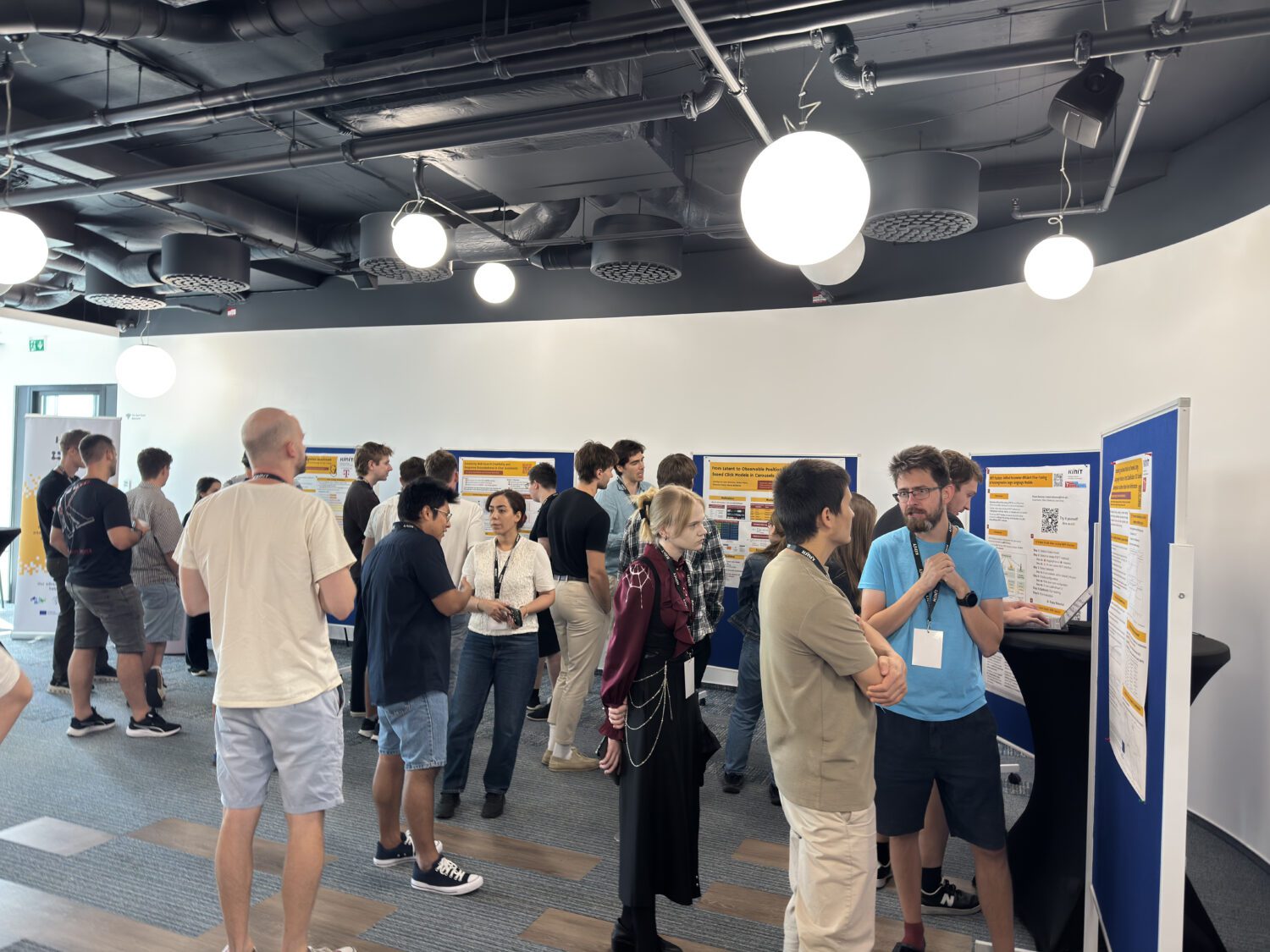
The Poster session became one of the highlights of the whole summer school. Participants could talk directly with KInIT PhD students and interns, learn about their projects and ask questions at their own pace. Many appreciated seeing what research at KInIT looks like up close.
We ended the summer school with the ethics panel AI as a reflection of our minds? Anthropomorphism and ethics of human-AI interaction. Adrián Gavorník moderated the discussion with Katarína Marcinčinová, Michal Gregor, Igor Farkaš and Nora Hargaš.
The conversation turned to anthropomorphism and the way people relate to AI. The panellists brought different perspectives and openly disagreed on some questions. Participants enjoyed that openness, and several said the discussion could have continued much longer.
Looking back at three days together
The lectures, panels and poster session received an average rating of 8.7 out of 10. In their comments, participants often mentioned the practical examples and the opportunity to speak directly with researchers. The friendly atmosphere also came up again and again.
They also told us what we could improve. More guided exercises would make the most technical topics easier to follow, and some sessions could use a little more breathing room. We are grateful for the honest feedback and will keep it in mind when planning the next edition.
Thank you to everyone who joined us and to the partners who helped make the summer school possible. Many participants said they would be happy to come again, and we would be happy to welcome them back.
“This year was special. The programme was a lot more varied than in the previous iterations, with the two panels and a poster session. There was also a lot of new, interesting content, including sessions on agentic AI and on speech. But most importantly, we had a great group of participants again this year – it was a lot of fun and when everybody left on Friday, I realized that I was going to miss them!”
Michal Gregor
Researcher