What's

Oct 27. 2025
KInIT at the European Researchers’ Night 2025
This year, we once again took part in the European Researchers’ Nightfestival, which brings together scientists, innovators, and anyone curious to learn more about the world of science. This year’s theme was CHAOS, which opened the door to fascinating discussions about unpredictability, complexity, and the order hidden in apparent disorder.
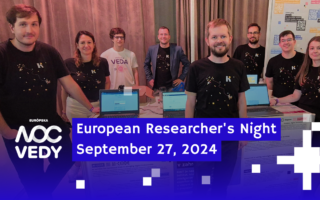
More than 70 scientific stands, 19 lectures, 6 discussions, and 10 workshops awaited visitors at the Old Market Hall in Bratislava. KInIT couldn’t miss out! Our goal was to show how artificial intelligence helps bring order to the chaotic world of data. Visitors could talk to our researchers, try out interactive demonstrations, and discover how AI not only analyzes but also creates.
At our stand, we presented the concept of I get AI – a space where visitors could easily and enjoyably learn about the world of artificial intelligence. We wanted to show that AI does not have to be complicated or scary. On the contrary, it is a tool that can help us better understand the world around us.
We prepared various activities and interactive demonstrations: visitors learned how AI recognizes misinformation, verifies facts, analyzes social networks, and helps create a sustainable future.
The highlight for both kids and adults was our interactive quiz on topics like misinformation, fact-checking, eye tracking, ethics, low-resource AI and green energy. Each topic sparked new questions and discussion – from deepfakes to social media content selection.

We also introduced projects such as DisAl, CEDMO, VIGILANT, AI-CODE, and vera.ai, focused on fighting misinformation, AI AUDITOLOGY for social media audits, Eyes4ICU for eye tracking, and lorAI for low-resource models. We presented ethical AI systems, including ALFIE, Techne, and SensAI, as well as green energy projects such as V4Grid.
Among interactive activities were the word game HadAI, testing language skills by guessing a five-letter word, and the playful Diakritikovač, showing how missing diacritics change meaning.
The project Inside AI revealed how AI makes decisions and where it can go wrong. In the REBUS game, participants designed a model household, adjusted solar panels and batteries and observed the impact on energy balance. In the CEDMO Game, players tried to trick models by detecting false information. Other interesting tools included the Fact-check finder and Machine-generated Text Detector. On a practical level, we presented a Semantic Search Engine showing how AI finds precise information across datasets.
Finally, we added a touch of fun and philosophy with the Regulated Chaos game, where visitors became European lawmakers deciding which AI systems pose risks and which should be allowed.

The atmosphere at our booth was full of energy, laughter and curiosity. People shared their thoughts, asked questions and discovered new ideas. For us, it was an opportunity to show how AI connects science, technology and everyday life.
This is what the European Researchers’ Night is all about. Bringing people together, exploring and not being afraid to enter a world where chaos can lead to order.
What were our team’s feelings during the event?

Our PhD student Ivana Beňová opened the event with her talk “You Can Do Science in Slovakia”, showing that high-level research and international collaboration are possible right here at home. Her presentation attracted many young visitors who actively engaged and showed genuine interest in artificial intelligence.
Ivana emphasized the importance of motivating young people to pursue scientific careers and to see that meaningful research can thrive in Slovakia, too. “I was surprised by how many children came so early in the morning and how attentively they reacted. I hope they took something from the talk and that some of them will become future researchers in artificial intelligence.”
She also reminded everyone that AI is not something to fear but a tool to help us when used wisely. “People often worry that AI will take their jobs or control them, but its capabilities are still limited. It’s a helper meant to make our lives easier. We just need to set clear rules and not be afraid to experiment.”
Our researcher, Kamil Burda, noticed a great interest in artificial intelligence, its functioning, benefits, and potential pitfalls across all age groups. “Several visitors who use ChatGPT noted that it sometimes tries too hard to please them, meaning it doesn’t contradict them,” Kamil stated.
“I was pleased that even the younger students who stopped by realised that AI’s answers are not always accurate and therefore verified them afterwards. I was also delighted by the interest shown by several visitors in pursuing a PhD or exploring career opportunities at KInIT.” Kamil added.

Also, our PhD student Ivan Vykopal mentioned the great atmosphere at the booth and the strong interest in AI and its proper use. “The atmosphere was fantastic; throughout the day, many people stopped by who were interested in AI and tried out ChatGPT, so many of the conversations revolved around this topic,” Ivan said.
“Our aim was to show that there is no need to fear AI, but it is important to use it responsibly and to verify the information these tools generate, which is also a topic we focus on at KInIT. Overall, I view the European Researchers’ Night very positively, and it was amazing to see how many people are interested in science and in what we do at KInIT,” he added in conclusion.


Why are such events important for young people?
Our Partnerships Manager Lucia Kotuľáková emphasized that the European Researchers’ Night is a great opportunity to bring the work of scientists and researchers closer to the public. She explained that the event creates space for interaction and that science has a lot to offer children, young people, and adults alike.
“Our mission at KInIT is to promote responsible innovation, expand knowledge, and nurture talent,” Lucia said. “Through raising awareness about research in artificial intelligence, we aim to show people what we do and how, through international projects, they can take part in global research directly from Slovakia. We also want to help companies advance by applying the latest AI insights.”
According to her, AI often seems complex because people don’t understand how it works. “Many are worried about using it and its impact on everyday life,” she noted. “That’s exactly why KInIT participates in the European Researchers’ Night – so that everyone can come, ask questions, gain new knowledge, and experience firsthand what we do at the only AI research institute in Slovakia.”
Lucia also emphasized that at KInIT, we support the growth of young talent through the BrAIn civic association. “I believe that events like the Researchers’ Night can inspire curiosity about science and research and perhaps guide some future researchers on their path,” she concluded.