What's
May 27. 2026
AI Awards Finalist: DAITABLE and energy AI built on trust
This year’s AI Awards finalist DAITABLE is a Slovak technology company that helps businesses reduce energy costs and increase sustainability through advanced automated data analysis and artificial intelligence. The company develops its own energy management system DAITAMONITOR, which enables real-time consumption monitoring, demand forecasting, and fault detection. It operates primarily in energy-intensive sectors such as industry and healthcare, and its references include the Presidential Palace and the Central Military Hospital in Ružomberok. We spoke with Tomáš Tánczos, who at DAITABLE serves as Software Engineer Team Lead and leads the data team.
What is DAILIBOR and what problem does it solve?
DAILIBOR is a multi-agent AI chatbot for industrial energy analytics, a virtual energy manager that helps companies understand their consumption, identify waste, and quantify savings opportunities. An energy manager in an industrial enterprise has hundreds of measuring points generating data every second, which makes manual and detailed analysis often impossible. DAITABLE’s goal is to process this data within a few minutes and provide answers to questions such as: when was consumption at its highest, how does it differ from the historical average, and what is the potential saving from shifting load to cheaper tariff bands.
AI Awards highlights systems built on the pillars of ethics, reliability, and privacy. Which of these aspects presented the greatest challenge during the development of your solution?
Reliability, specifically the fight against hallucinations. Large language models inherently struggle with numbers and generate non-existent data where information is missing. In industrial energy management, this is critical, because an inaccurate figure about a machine’s consumption can lead to a bad decision. Moreover, with large volumes of data, in our case primarily time series spanning weeks and months of measurements, summarisation is necessary, and this is where LLMs tend to fabricate information. For this reason, the agents in our system never have direct access to the data; they only see the header and a sample row. Their task is to generate analysis code that runs in an isolated environment. In this way we ensure both data privacy and reliability.
What specific mechanisms ensure that your solution remains under human control and stays secure in the long term?
Our system is designed purely as an analytical tool, not an automation, and the decision always remains on the user’s side. The system’s responses include not only verbal recommendations and analytical evaluations, but also visual confirmations in the form of charts and attached datasets on the basis of which the chatbot made its decisions.
What do you see as the greatest societal challenge in the field of AI, and what role does DAITABLE want to play in addressing it?
The greatest challenge is trust. If people and companies do not trust AI systems, they will not use them and the benefits of AI will go unrealised. In our domain we see this very concretely: an energy manager who does not trust a number from AI will return to manual analysis using already proven methods. From our perspective, the problem is not technological but architectural. Most AI systems are designed to maximise performance, not the verifiability of outputs. At DAITABLE we believe that the future of AI lies in systems that are a glass box. That is why we are building an architecture where the steps of the system are communicated to the user, every output must be verifiable, and every limitation of the system communicated.
Where do you see the future of DAILIBOR, and how will it deepen collaboration between technology and people?
The goal is the evolution of our system from a reactive assistant toward a proactive energy partner. In the near future we will be deploying automated reports delivered directly to users with identified savings and anomalies, without them having to actively ask questions. The long-term aim is integration with our entire product portfolio, where DAILIBOR will serve as the analytical layer between raw industrial data and human decision-making. The goal is for the user to be able to focus on what makes them irreplaceable: strategic decision-making and running the business.
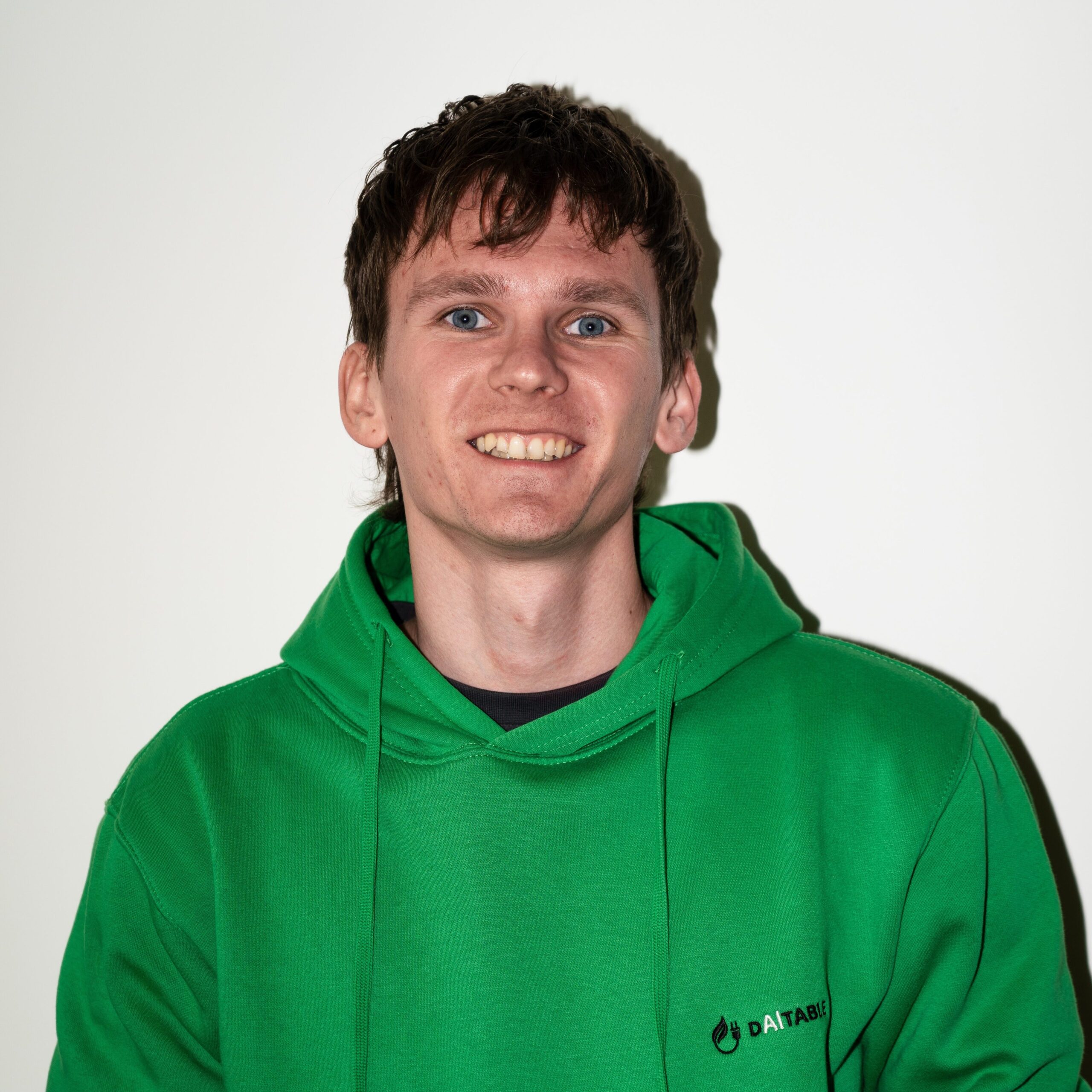
Tomáš Tánczos professionally focuses primarily on working with data, from data engineering and predictive ML models to deploying end-to-end solutions in production. He studied software engineering at STU in Bratislava, where he currently continues as a doctoral student with a dissertation focused on the interpretability of deep learning methods in medicine. At DAITABLE he leads the data team and is responsible for the development of the analytical engine and the multi-agent AI chatbot for industrial energy analytics. He approaches the topics of trustworthy AI from both sides: in practice he designs architectures ensuring transparency and verifiability of AI outputs, while in academic research he works on model explainability.
Tomáš Tánczos
Software Engineer Team Lead, DAITABLE