


What's
Oct 19. 2026
My Three Months in Graz: Exploring Physics-Informed Machine Learning for Solar Forecasting
From April to June, I spent three months in Graz, Austria, on a research visit at Know Center, funded by the ENFIELD consortium through their 4th Exchange Scheme Open Call. The visit gave me the opportunity to work closely with researchers in Graz on the following question: How green is physics-informed machine learning in solar power forecasting?
The Research Question
Solar power forecasting is important because electricity production from photovoltaic systems depends strongly on the weather. Being able to estimate how much solar energy will be produced the next day helps grid operators plan ahead and balance production and demand.
Machine learning models can already perform this task quite well by learning from historical solar production and weather data. The idea behind physics-informed machine learning (PIML) is to provide these models with additional knowledge about the physical processes involved. Instead of asking an AI model to discover every relationship from data alone, we can incorporate some knowledge about how solar panels should behave under different levels of sunlight and temperature.
Our original intent was exploring the development of energy efficient AI models using PIML, often referred to as Green AI or Frugal AI. We wanted to find out whether including physical knowledge could make a machine learning model more computationally efficient and less power hungry. If a physics-informed model could reach the same forecasting quality with less training, it could potentially require less computing power and therefore less energy. For this purpose, we combined a strong neural network for time series prediction tasks (TSMixer) with the physical PV panel efficiency model (ADR) to explicitly model effects such as efficiency losses caused by panel overheating.
A Europe-wide Solar Forecasting Dataset
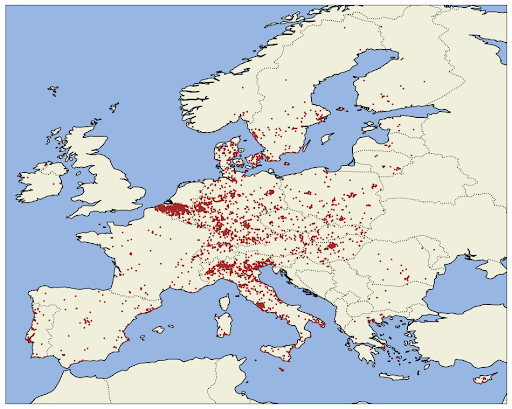
A key part of this work was the dataset collected by my colleague at KInIT. It contains data from 3,713 photovoltaic installations across 33 European countries, covering the years 2020 to 2023 and amounting to more than three million daily samples. Alongside solar-power production, the dataset includes weather forecasts and information about the individual installations.
Having data from thousands of installations across Europe from the get-go helped to accelerate our research and allowed us to test the models under a wide variety of conditions in the timeframe of the research visit.
We think the dataset can be useful for other researchers as well, and we are working towards making it publicly available. Stay tuned for more information about the dataset and its release.
The Results
In our initial experiments, the physics-informed approach did not really reduce the required training time that much, often quite the opposite. We therefore pivoted and broadened the research question. Instead of looking at electricity consumption during training, we investigated several of the general claims often associated with physics-informed machine learning. We also evaluated the performance on unseen locations to evaluate generalizability of the model and tried training it with less data to see whether the physics-informed approach can help there as well.
While the physics-informed models we developed showed a small accuracy increase during the training, this did not lead to better accuracy on test data. They also did not consistently perform better when we tested how well models transferred between countries or when we deliberately reduced the amount of training data available.
In other words, simply adding physical knowledge to a machine learning model does not automatically make it more accurate, more efficient, or better at generalizing. In our case, the standard machine learning model was already able to predict the PV production well from the large amount of available data. The results suggest that the benefits of physics-informed machine learning depend strongly on the application, the quality of the physical model, the amount of available data, and the way the two approaches are combined.
Life in Graz
The research visit was also a chance to spend three months living in Graz and getting to know the city.
I stayed in a riverside dorm close to Augarten, a large park near the centre of Graz. It was one of my favourite places in the city. I regularly passed a family of swans there and got to watch the baby swans grow over the course of my stay.
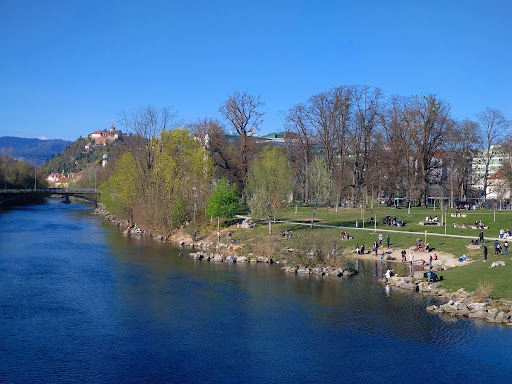
I also really enjoyed how easy it was to move around Graz. The city has a great network of bike paths, and although I did not bring a bike, they were also perfect for getting around on my longboard. I rode all over the city and used it to commute to the Know Center at the TU Graz campus.
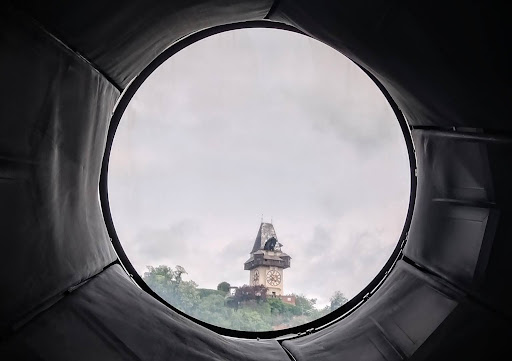
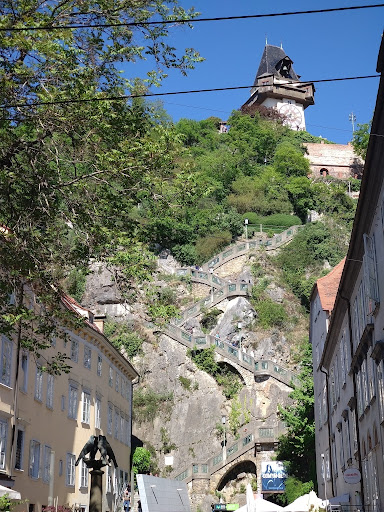
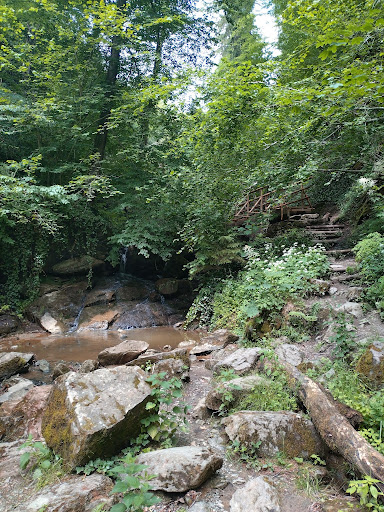
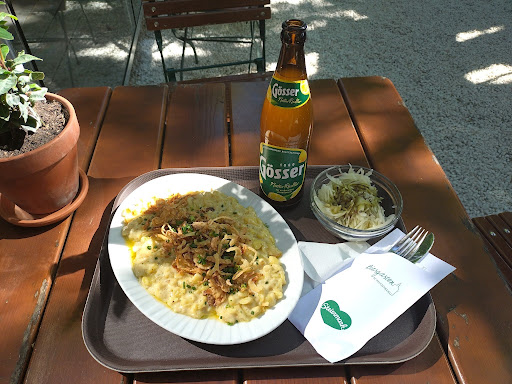
Outside work, I tried to see some of the city and its surroundings as well. One of the obvious highlights was walking up the steps to the Schlossberg and the Graz Clock Tower, which overlooks the historic centre. I also visited Eggenberg Palace and its gardens, and went for a short hike through Rettenbachklamm, a wooded gorge on the outskirts of the city. And I had to try the traditional Styrian Käsespätzle while I was there, of course!
Looking back
My three months in Graz were a valuable opportunity to work on a focused research question, exchange ideas with researchers at Know Center and TU Graz, and explore a new city at the same time.
The visit started with a question about the energy demands of physics-informed machine learning, but the first results forced us to pivot and look for other benefits. While I did not develop a groundbreaking new model, I gained a better understanding of when adding physical knowledge to machine learning can actually be useful.
The results of the visit have been summarized in a manuscript “The Utility of Physics-Informed Machine Learning in Solar Power Production Forecasting”, currently under peer review. Beyond the research, I will remember my months of life in Graz fondly, not only because of the city, but also because of the friends I made there.

